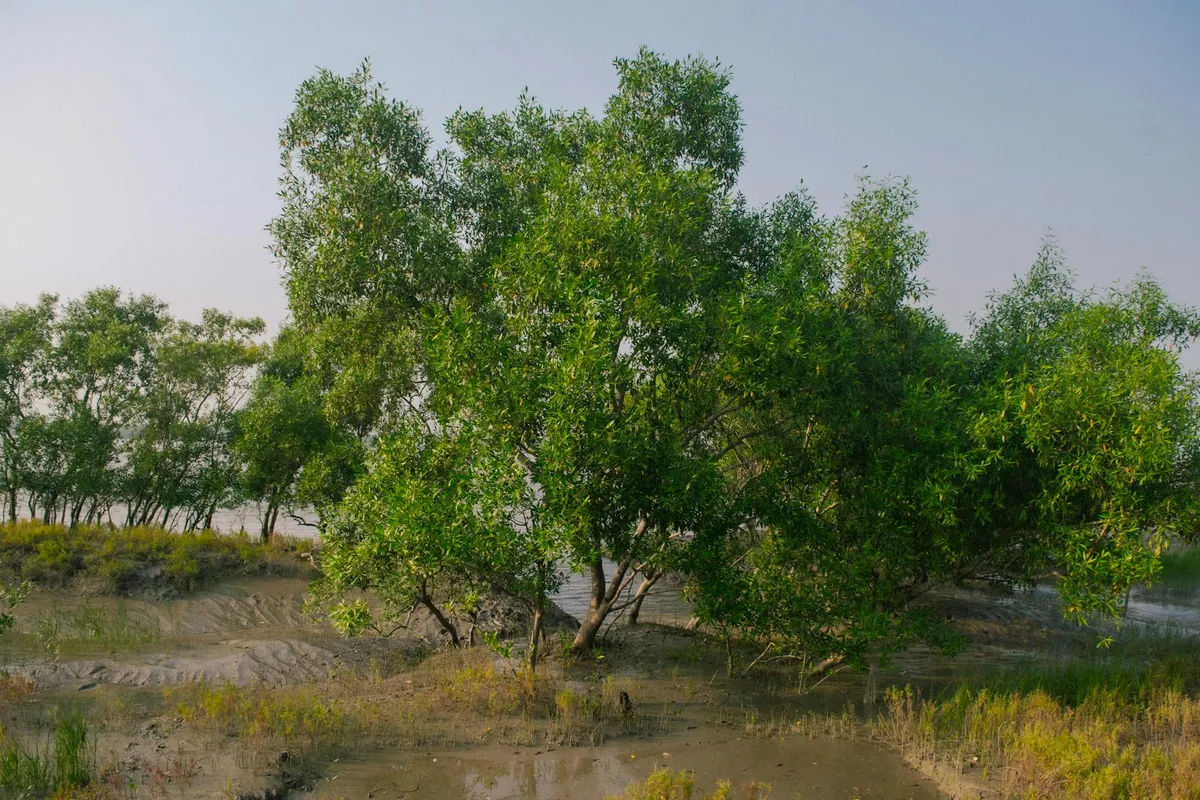
If you take a small boat through the channels of the Hara mangrove forest along Qeshm's northern coast in the early morning, you will see something unusual: a forest that grows in salt water. The trees rise from the tidal flats, their roots arching into the water, their canopies reaching the sky. Birds move through the branches. Fish move through the water below. The whole system functions in a way that no other ecosystem quite duplicates.
Mangrove forests are among the most distinctive ecological systems on Earth. They occupy the narrow zone where land meets sea in tropical and subtropical coastlines. The Hara forest at Qeshm is one of the most substantial mangrove ecosystems in the Persian Gulf region.
What mangroves actually are
Mangroves are trees that have evolved to live in salt water. This requires several specific adaptations that most plants cannot make.
The roots have specialized salt-filtering mechanisms that exclude most salt from the water the tree absorbs. Some species also have salt-excreting glands on their leaves to remove what salt does enter the tree. The roots themselves are typically shallow but spreading, providing stability in soft tidal sediments while also getting oxygen through breathing roots that extend above the water surface.
The reproductive strategy is also distinctive. Many mangrove species produce seeds that germinate while still attached to the parent tree, forming small plant-like structures that drop into the water and can drift with currents until they find suitable mudflats to colonize.
These adaptations allow mangroves to thrive in a habitat that excludes most other plant species — the saltwater-influenced tidal zone where conditions change with every tide cycle.
What mangrove forests do ecologically
Mangrove forests perform several ecological functions that other systems cannot match:
Nursery habitat for marine species. The complex root systems provide protection for juvenile fish, crabs, and shellfish. Many commercially important fish species spend their early life stages in mangrove forests before moving to open water as adults.
Carbon sequestration. Mangrove forests are among the most efficient carbon-storing ecosystems per area. They sequester carbon in both the trees themselves and in the deep tidal sediments where the carbon can remain stable for centuries.
Coastal protection. The dense root systems and substantial vegetation reduce the impact of storms, waves, and tidal surges on coastal areas. Mangrove forests provide natural infrastructure protecting human settlements from coastal hazards.
Water filtration. The roots and sediments filter pollutants and excess nutrients from water flowing through the forest, improving water quality for adjacent ecosystems.
Bird habitat. Substantial bird populations depend on mangrove forests for nesting, roosting, and feeding. The Hara forest hosts numerous species including specialized ones like herons, ibis, and various waterbirds.
These ecological functions are not abstract. They produce concrete economic value through fisheries, coastal protection, and biodiversity that depends on mangrove existence.
The Hara mangroves specifically
The Hara forest along Qeshm's northern coast covers approximately 9,000 hectares. The dominant species is Avicennia marina, a mangrove particularly adapted to the high-salinity conditions of the Persian Gulf.
The forest has been protected as a UNESCO biosphere reserve since 1976. The protection has been generally effective, with the forest extent stable or growing despite various development pressures throughout the region.
The forest supports substantial fishing activity for local communities. Specific commercially important species (various shrimp, mullet, sea bream) depend on mangrove nursery habitat for their reproduction. The fishing economy of northern Qeshm depends substantially on this mangrove-supported productivity.
The economic and cultural integration
The mangrove forests are not separate from human life on Qeshm. They have shaped the island's economy and culture for centuries.
Fishing communities have developed specific knowledge about working in and around the mangroves. Boat building traditions are adapted to navigating the channels. Fishing methods are matched to the species and seasons that the mangrove ecosystem supports.
Specific cultural traditions on Qeshm reference the mangroves. Local stories, place names, and seasonal observances all reflect the centrality of the mangrove ecosystem to island life.
This integration of human culture and ecology represents what successful long-term coexistence with productive ecosystems can look like. The mangroves have supported human communities for centuries; the human communities have generally avoided destroying the mangroves they depend on.
The contemporary pressures
Despite formal protection, the Hara mangroves face several contemporary pressures:
Climate change. Sea level rise affects mangrove distribution. Temperature changes affect species composition. Storm intensity changes affect forest dynamics.
Pollution. Industrial development in the broader Persian Gulf region produces water pollution that affects mangrove health.
Coastal development. Tourism and infrastructure development create pressure for coastal land use that conflicts with mangrove preservation.
Fishing pressure. Fishing in mangrove channels can damage habitat if not managed carefully.
Tourism management. The forests attract tourism that produces both economic benefits and management challenges.
Sustained mangrove preservation requires sustained attention to these pressures. The protective designations are necessary but not sufficient.
What the mangroves teach
I find the mangrove ecosystem interesting partly because it demonstrates the productive value of edges in nature. The boundary between land and sea is often treated as a problem to be managed (waves, erosion, salt damage). The mangroves treat it as productive territory to occupy.
The result is a system more biologically productive than either pure terrestrial or pure marine ecosystems. The edge produces value that the interior does not.
This pattern appears in many ecological contexts. Edges between different habitats often support distinctive communities adapted to the transition zones. The boundaries are not the limits of ecological function but specific zones where particular kinds of function happen.
A closing observation
The Hara mangroves continue. The trees grow. The roots arch. The fish nursery in the protected channels. The birds nest in the canopies. The fishing communities harvest what the mangroves support.
This particular ecosystem has functioned for thousands of years. With continued protection and management attention, it can continue functioning for thousands more.
The mangroves do not need anything from human activity to thrive. They need only that human activity not destroy them. The continuation depends on choices currently being made and that will continue to be made about how to coexist with these productive forests.
The forest grows. The tides come and go. The system continues. The continuation matters substantially for both ecological and human reasons.