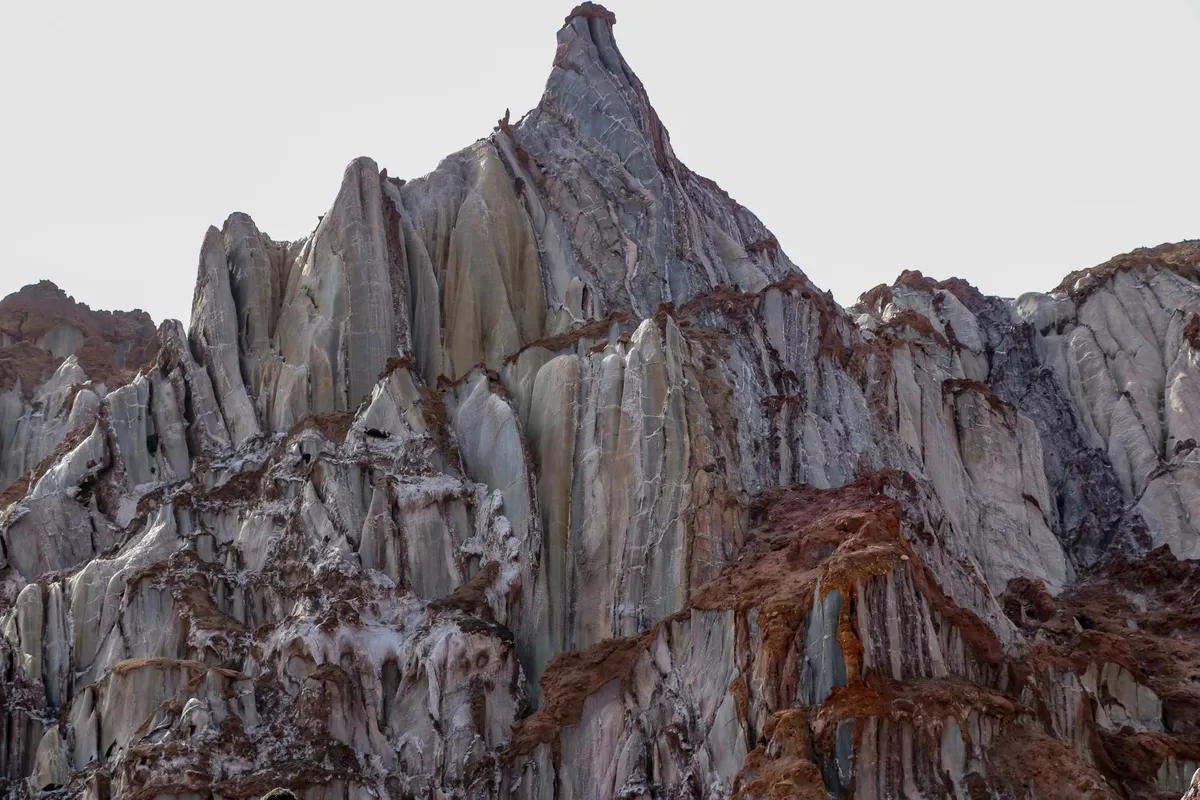
If you walk through certain parts of Qeshm Island during the late afternoon, you will see hills that are unlike any hills you have seen elsewhere. They are pale, almost white in the sunlight. Their surfaces are sculpted into intricate patterns by wind and rain. In some places, the wind has cut narrow canyons that you can walk through, the walls rising twenty feet on either side, the floor crunching slightly underfoot.
These are the salt domes of Qeshm. They are among the most distinctive geological features on Earth. They have formed across millions of years through processes that operate on time scales that human experience cannot really grasp.
What salt domes actually are
Salt domes form when deep underground deposits of salt, originally laid down by ancient seas, rise toward the surface through the overlying rock. Salt is less dense than most other rock; under pressure, it flows slowly upward through weak points in the surrounding geology, eventually breaking through to the surface where it can be sculpted by weather.
The Hormuz salt formation that produced Qeshm's salt domes was deposited in shallow seas approximately 540 million years ago, during the late Precambrian or early Cambrian period. The salt then sat under accumulating sediment for hundreds of millions of years. Tectonic forces pushed and squeezed the region. The salt began rising, slowly, through the rock above it.
The salt domes visible on Qeshm today are the result of this rise reaching the surface. The exposed salt is then weathered by the region's rare but intense rains, which dissolve and reshape the salt into the formations we see now.
The time scale
The time scale of salt dome formation is genuinely difficult to comprehend. The salt that became Qeshm's domes was deposited approximately when complex multicellular life was first emerging in Earth's oceans. It then sat through the entire evolution of plants, the colonization of land by animals, the rise and extinction of dinosaurs, the emergence of mammals, and the development of human civilization.
The salt rose toward the surface during this time, but slowly. The rate of salt dome rise is typically measured in millimeters per year. The 540-million-year journey from initial deposition to current surface exposure represents an average rate so slow it seems almost stationary on human time scales.
The patterns currently visible on the salt dome surfaces have been sculpted by weather over the past several thousand years. They will continue to change. The salt dissolved by today's rain will be replaced from below by salt that has been rising for millions of years.
The cave systems
One of the most distinctive features of Qeshm's salt domes is the cave systems within them. Salt is soluble in water; over time, water flowing through the salt has carved cave systems that extend for kilometers underground.
The longest known salt cave in the world — the Namakdan Cave on Qeshm — extends for over six kilometers. The cave passages are sometimes wide enough to walk through comfortably; other sections require crawling. The walls are pale salt, often crystallized into beautiful patterns by the slow cycles of dissolution and recrystallization.
These caves are still being shaped. New passages form as water finds new paths through the salt. Old passages collapse as the salt around them dissolves. The cave system that exists today is different from the one that existed a thousand years ago, which was different from the one before that.
What the geology shapes
The salt geology of Qeshm has shaped the island's ecology, economy, and human history in specific ways.
Ecology: The salt-influenced soils support specific plant communities adapted to high salinity. The salt itself has been a resource for fishing communities throughout the gulf for centuries.
Economy: Salt mining was a substantial historical activity on the island. Fishing communities throughout the Persian Gulf used Qeshm salt to preserve their catches. The trade in salt connected Qeshm to ports throughout the region.
Human geography: The salt domes have always been visible landmarks. Settlements developed in relation to them. Stories and traditions formed around them.
The geology is not background to human life on the island. It shapes how human life happens.
The contemporary attention
The salt domes are now substantial tourist attractions. UNESCO has designated parts of the area as a Global Geopark. International visitors come to see the formations and walk through the caves.
This attention has been generally positive for the island, providing economic benefits to local communities. It has also produced specific challenges around managing visitor numbers, protecting the formations from damage, and maintaining the ecological balance that the formations have produced over millions of years.
The geology that took 540 million years to develop deserves substantial care. The current management approach seems generally adequate to the responsibility but the ongoing balance between access and preservation requires sustained attention.
What the geology teaches
I find the salt domes interesting partly because they make geological time scales unusually accessible. Most geological features are old beyond human comprehension; we know they are old but cannot really feel it.
The salt domes feel old in a particular way. The wind-sculpted patterns suggest the slow continuous work of weather over centuries. The cave systems suggest the patient work of water over millennia. The 540 million years of salt formation are abstract but the immediate landscape that those years produced is directly visible.
Standing on a salt dome at sunset, with the white surfaces glowing pink in the late light, the time involved becomes more accessible than most geological time scales allow. The patient processes of geology are visible at human scale.
A closing observation
The salt domes of Qeshm continue to change. The salt continues to rise from below at its imperceptibly slow rate. The weather continues to sculpt the exposed surfaces. The cave systems continue to shift.
The current generation of visitors sees a landscape slightly different from what previous generations saw and slightly different from what future generations will see. The differences are small at any given moment but accumulate substantially across centuries.
This is the long rhythm of geological change happening at landscape scale. It is older than the island's human history. It will continue long after any current human concern about the island has been forgotten.
The salt rises. The rain falls. The patterns shift. The landscape remembers.